Memoir回憶錄回忆录
外公的书,背后那穿越百年的往事Grandfather’s Book and the Century-Old Story Behind It
Professor CK Yuan writes about his grandfather’s book, first published 76 years earlier and recently reprinted in Beijing, and the hundred years of history behind it.
袁傳寬教授記述外公的書:76年前民國時期的出版物,近年在北京再版;以及書背後穿越百年的往事。
袁传宽教授记述外公的书:76年前民国时期的出版物,近年在北京再版;以及书背后穿越百年的往事。
本文保留原文的簡體字。
作者袁传宽教授毕业于北京大学,后留学美国,获加利福尼亚大学数学博士学位。迄今执教逾40年,其中20年在在国内清华大学,20年在美国圣塔芭芭拉加州大学,佩伯丁大学,圣塔克拉拉大学,国际科技大学。曾任美国国际科技大学副校长,还曾先后担任清华大学三个研究所的所长与中关村创新研修学院院长。
Contents目錄目录 (5)
外公的书,背后那穿越百年的往事
袁传宽
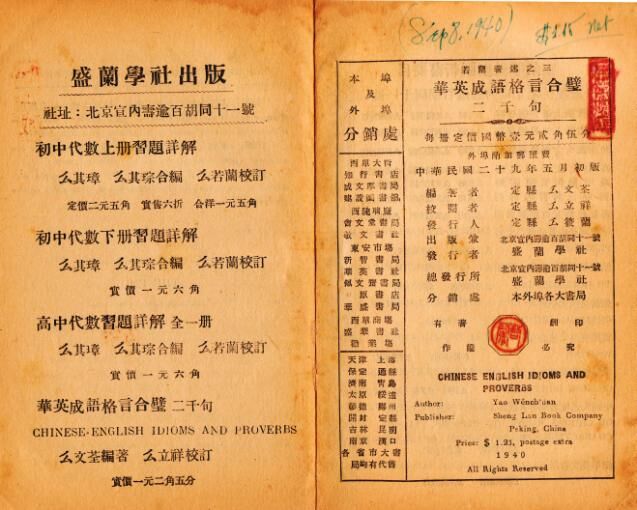
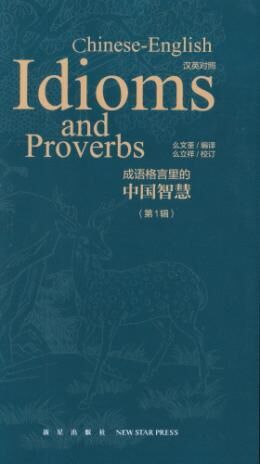
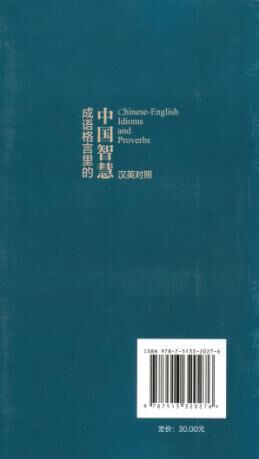
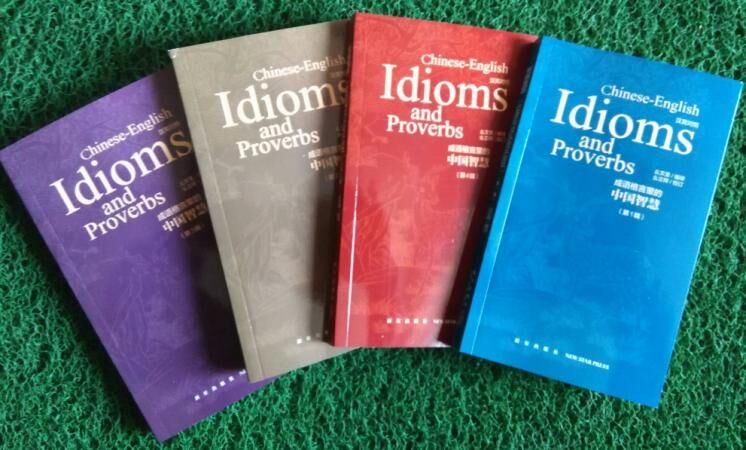
本人年逾古稀,先外祖父若是在世,今年将近 130 岁了。他老人家的书,当然是他生前的著作,确切地说是 76 年前、民国时期的出版物。如今,这本书经北京的“新星出版社”整理再版,再次印刷面世了。于是,外公的书有了两个版本:一是民国版,原书名叫《汉英成语格言合璧二千句》,其中的中文部分是繁体字的,由“盛兰学社”1940 年出版,其英文书名是《Chinese-English Idioms and Proverbs》。二是 2015 年新版,更名为《成语格言里的中国智慧》,简体字的中文,其英文书名与原版相同。两个版本的署名都是么文荃编译,么立祥校订。前者是我的外公,按家乡习惯,我喊他“姥爷”,后者是我的曾外祖父,我没见过。
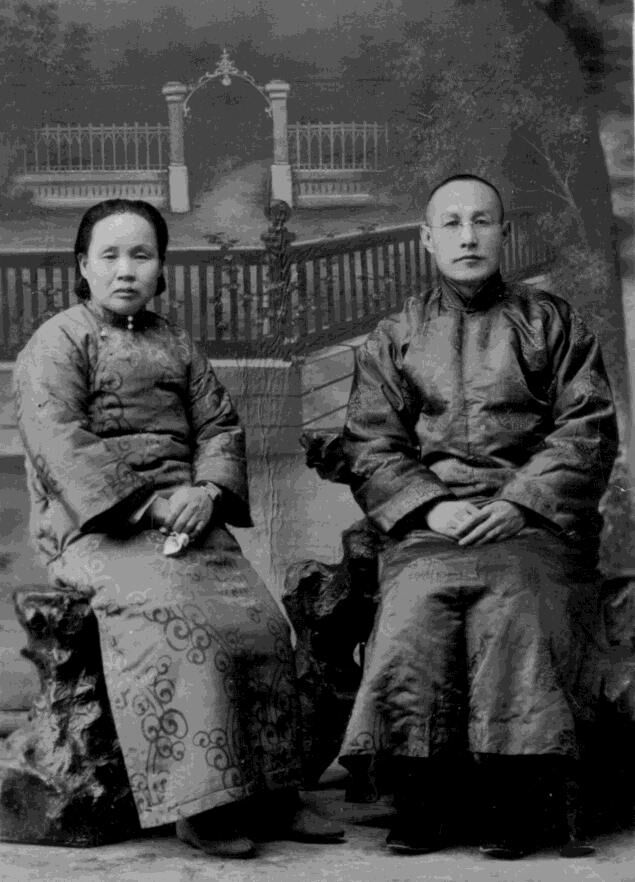
曾外公与外公,“盛兰学社”
2015 年的新版书,在其前、后勒口处,相继印有介绍我的这两位先人和“盛兰学社”的一段话,谨抄录如下:
么立祥,河北定县人,清末光绪年间举人,乡绅,家道殷实,依靠家财与志同道合者的捐助办学惠民,获满城称赞,乡里有童谣流传至今:“东亭镇,街道长,出了个举人么立祥;拆大庙,办学堂,满城都赞么立祥。”为维持学堂,么立祥典屋、卖地,几近破産。
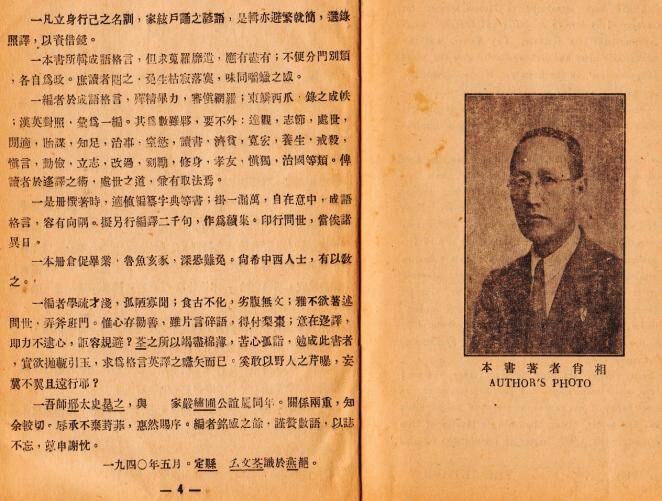
么文荃,么立祥之子。生于 1889 年。儿时读私塾。1906 年东渡日本留学,在早稻田大学主攻化学。四年学成回国,先后在家乡,保定和北平谋生,在各地的专科学校教授物理和化学等课程。后于“北平国立艺专”担任训导主任与英文教授。同事尽是著名书画家,如齐白石、寿石工、顔伯龙等。北平沦陷后,长期赋闲,家庭生计出现危机,为稻粱谋,以翻译为生。
么文荃眼见四个儿女都已成才,各有所长,于是想到办一个出版社,只出版自己家人的作品。么文荃号若兰,于是让子女依次取号:次兰、少兰、筱兰和幼兰,出版社定名“盛兰学社”最为贴切,既雅致又吉祥。
么文荃擅长中英翻译,将朱柏庐的《治家格言》,孔子的《论语》等相继翻译成英文。其子女创作小说,编写教材读物,设计封面,各尽其力。有感于“欧亚文化之沟通,东西文明之握手,端赖英语间为其介……而我国成语格言之英译,殆如凤毛麟角,尚属罕觏”,遂立志将中国格言成语译成英文,“以寸晷之暇,汇录成语格言,数达二千。悉心移译,不厌求详”,“藉作涉世之楷模,淑身之法式”。
1949 年,么文荃逝世,“盛兰学社”寿终正寝。
坐拥书城
先母是外公的长女。我是外公的长外孙,自小深受他疼爱。外公手不释卷,常常是一手拿书,一手把我揽在怀里。我即使把他的皮袍子尿湿了,他也不以为意,仅令我母为他擦拭干净即可。在我呀呀学语的时候,他教我学说英文。
外公偏爱我,据说他没有抱过其他的孙男孙女。我的表妹莉蕾,不到一岁时跟着她的画家妈妈,即我的二姨,离开北平,跨洋越海去了台湾。30 多年后,我正在美国留学,她从台湾到美国来看我,还“抱怨”说:“姥爷在我出生后,没抱过我,只指着我的鼻子说:‘以后替我好好气气妳妈!’说完就转身走了。”莉蕾是听二姨说的。
1949 年,我 5 岁,外公沈疴日重,入住北平“中央医院”,它后来更名“人民医院”,如今叫“北京大学附属人民医院”。我是被外公召到他病房床前,做最后诀别的唯一孙辈。外公下葬时,舅父令我和他并排跪在那即将埋葬棺木的大坑边缘,轮流举幡,为外公招魂。
记得外公出殡那一天,正是解放军进驻京城的时候。外公生前家住西城寿逾百(音“伯”)胡同。此条胡同南北两侧的屋檐下或门洞内,各处都有进城的解放军士兵在歇息。我家的门洞内也有几位,他们把枪枝和背包行李放下来,席地而坐。除了向我家讨水喝外,不轻易进入大门。我很好奇,羡慕地看着他们,甚至摸摸他们的枪枝。
“盛兰学社”就在这改朝换代的时节,随着外公的去世而寿终正寝。出版社倒闭了,没有卖出的各类书籍,一梱又一梱,堆放在一间屋子里,从地面一直堆高到天花板,占据了半间屋子。等我到了上小学的年纪,这里就成了我的游乐场。我用那成梱的书,当作“积木”,搭建城楼和阶梯,从地面到屋顶,爬上爬下,浑身沾满尘土,却乐此不疲。“坐拥书城”本是一句比喻,我小时候可是实实在在地“坐拥书城”的!
我上中学后,似乎开始懂事了,就拆开那一梱梱的包装,仔细地读那些书了。首先喜欢读的是,“盛兰学社”出版的那些初等数学辅导书,升学指导与题解之类。我还读了三姨创作的短篇与中篇小说集,有《洞房花烛夜》和《七姊妹》。其实三姨是北京大学数学系的学生,15 岁考进北大的,数学读得轻松愉快,于是又兼学文学,受到时任文学院院长、后继任北大校长的胡适先生之表彰与鼓励。常常有人问三姨:以何为专业?以何为职业?她回答说:“那得看您问的是哪一年?”真的,有些年三姨是专业作家,靠稿费为生;而有些年则是职业的数学教师,靠学校的薪水。三姨这些小说集的封面都是二姨亲手设计。
二姨从“北平国立艺专”(今北京的“中央美术学院”之前身)毕业后,留校当了助教,是职业画家。《洞房花烛夜》的封面是她画的一幅工笔仕女“窗前观春柳”。我上高中的时候,读完了舅父和三姨合作翻译的《范氏大代数》,原著即 Henry B. Fine 之《College Algebra》。阅读这些书,我获益匪浅,不仅喜欢数学了,还奠定了我日后以数学为专业的基础。此外,北京师范大学英文系毕业的舅父给我逐字逐句讲解过,外公翻译的朱柏庐所著之《治家格言》,我既学汉语,又学英文,还记下很多为人处事的道理,诸如:
“宜未雨而绸缪,毋临渴而掘井”;
“勿贪意外之财,勿饮过量之酒”;
“与肩挑贸易,勿占便宜。见贫苦亲邻,须加温恤”;
“善欲人见,不是真善。恶恐人知,便是大恶”;
“施惠勿念,受恩莫忘”。
照先外公的话,这些教条都可“藉作涉世之楷模,淑身之法式”。
付之一炬
后来家里住房紧张,人都不够住的,哪里还能半间屋子堆书?于是,家人忍痛把那成梱的书拉到“废品收购站”,当作烂纸打发掉!然而敝帚自珍,家人把每部书都留下数册当作“盛兰学社”的纪念。这些书和家里收藏的名家书画,都放在几个大书柜里。
外公身后留下来的几百件书画收藏,装满了十几只大箱子。其中我最喜欢的是,外公当年国立艺专的书画家同事们赠送给他的作品,因那上面有他们的题字落款,那些文字常常引发我对外公当年生活的无限遐想,又可排解我心中对他的思念。送给外公书画的尽是民国时期的名家,有齐白石、寿石工、顔伯龙、邱石冥、傅濡、周兆祥、溥心畬、黄宾虹、王雪涛和萧愻等人。他们送外公的有大幅的中堂、对联、册页手卷和镜心扇面。他们的作品有山水、人物和花鸟,或工笔或写意,或淡墨或重彩。我喜爱翻弄它们。
母亲喜欢把这些字画挂满四壁,一则美化,增强室内文化气氛;二则遮丑,盖住墙壁上面难看的斑渍。她每年夏天都要把那些大箱子打开,一一检视,通风清洁,防霉防蛀。尽管多年精心保护,却逃不过“大革文化命”的劫难。“文革”初期,这些珍藏被“破四旧”的红卫兵入室“抄家”、撕毁、践踏,最后在院中统统付之一炬。一幅溥心畬书写的两个大字“钓鳌”,母亲把它高高挂在门楣之上,悬挂了很多年,我从小就天天看到,那两个飘逸而苍劲的大字早已印在我心里。1966 年的一天,“破四旧”的来了,十几个佩戴“红卫兵”袖章的中学生,一拥而上,争先恐后,七手八脚早把墙壁上所有悬挂的字画撕扯下来。一位“造反小将”抬头望见“钓鳌”,四处巡视,找到一根竹竿,几下子把它挑了下来,立刻愤怒地撕成两片,双脚用力践踏,最后兴高采烈地丢到院中火堆里焚毁。于是革命造反成功,呼啸而去。留下的是满室狼藉,烟尘灰烬,未定的惊魂,永远的遗憾。
家里留存的“盛兰学社”的出版物,也被那一把火烧了个精光。书籍的主人虽然惋惜,觉得这不该是那些书的归宿,但总比再被人拉出来批判、践踏与亵渎好一些,就让它们和那些家藏的名家字画一同“归天”吧。
自此,我家连一本“盛兰学社”的书都没有了。“新星出版社”的总编辑助理孙志鹏先生,博览群书,读到我在 2010 年发表的一本散文集《走近大师,12 位科学家的美丽人生》。在其中的“代后记”里,我提及家世和“盛兰学社”等往事。没想到孙先生以出版家的敏感和慧眼,发现了其中的价值。他大海捞针,居然在互联网上的旧书店里,寻觅到民国版的《汉英成语格言合璧二千句》,继而策划、主持再版发行,堪称用心良苦。出版社上下同仁怀着极大的热情,群策群力编辑排版,装帧设计。“新星出版社”挖掘出沉睡了 70 多年的外公旧作,如文物出土,更为当今社会贡献出一本赏心悦目的时尚新版。
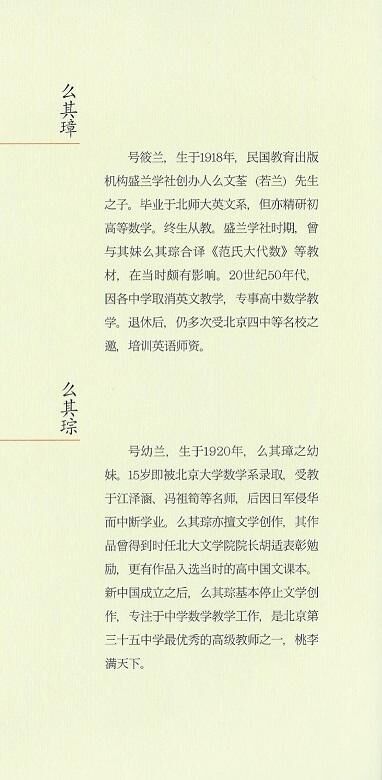
顺便提到,除此之外“新星出版社”还整理加工“盛兰学社”的另一本书。该书的原著是我舅父么其璋和三姨么其琮。二位当年搜集、合编了一本民国时代 30 年的各大学入学考试之数学试题与详解。如今,出版社将这本特殊文献集之范围扩大,更名叫《民国老试卷》。本书的腰封上印了一句很刺激的话:“回到民国,你还能考上大学吗?”一句提问,就引发了媒体关注,网友热议。
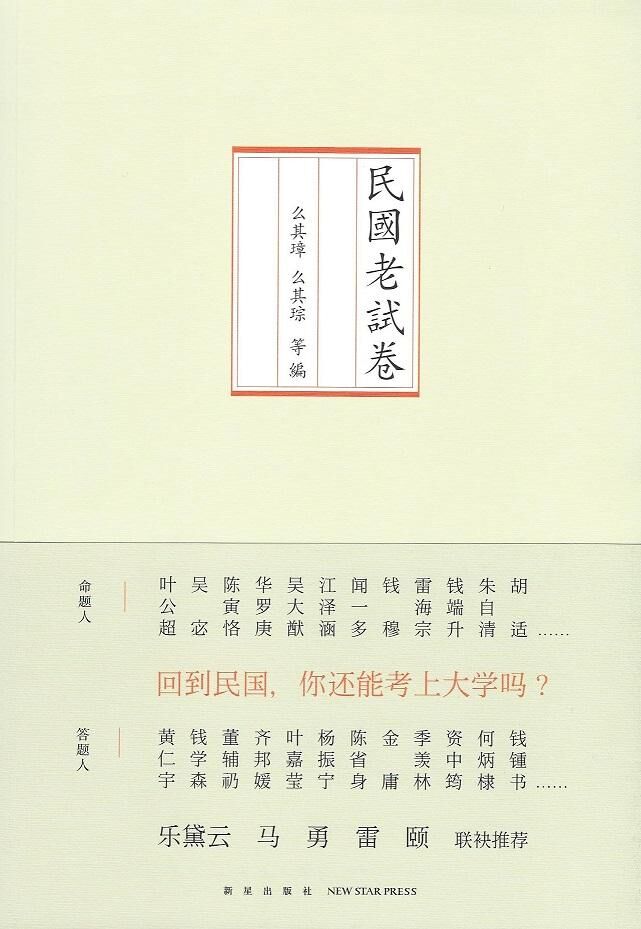
“回到民国,你还能考上大学吗?”对于这个提问的回答,是肯定抑或否定,都没错,至少在逻辑上没错,因为这个命题的前提“回到民国”事实上不成立!对此提问,何必较真?该较真的是,这本文献集或许会对当今的中学教育提供一个新的视角,启发革新的思路。温故而知新,不就是这个道理吗?
“信、达、雅”之我见
中英互译,本来就不是一件容易的事。严复老先生所提倡的“信、达、雅”已经渐渐被译者奉为圭臬。然而,这三个字当如何理解,也未见得都能一致。“信”字最好理解,简单说就是译文必须忠实于原作。可是“雅”,就不那么简单了!原文如果就是俚语俗话,若翻译得“雅”,还能忠实于原意吗?显然,翻译不能一味地以“雅”为追求,似乎应是该雅则雅,该俗就俗。换言之,根据原文风格,尽量做到雅俗得当。
“达”字的理解也成问题,一般把它解释为译文须“通顺,流畅”。我却不以为然。严复老先生当初怎么想出这个“达”字,我不得而知。但我以为对其合理的解释,应该是译文须表达出原文的含意,勿“词不达意”!诸多情况下,直译则不“达”。鲁迅先生不是早就嘲笑过,把“Milky Way”翻译成“牛奶路”吗?
“达”之难,尤其在中英格言成语的互译时。此时,如果译者功力不够,仅能照字面直译,难免就会出现词不达意的窘况。例如汉语说“剜肉补疮”,该如何翻译?如果照表面文字直译,译成血淋淋能把人吓个半死,也绝不能传“达”该成语之含意!再如“圣人面前卖文章”又当如何翻译?还有“惺惺惜惺惺”呢?
先外公大约在 80 年前就注意到了这些困难。他以为无论汉语或英语,其中的成语格言都包含着各自民族的智慧与哲理。必须跨越中西,深入研习与理解,把那些内含有相似的智慧与哲理的成语格言,对应起来,方能实现“欧亚文化之沟通,东西文明之握手”。力争翻译出两种语言背后的“文化”与“文明”,才是“互译”汉英成语格言之上策。以下从外公的书中,挑举三例说明之。
“剜肉补疮”与“To rob Peter to pay Paul.”
“圣人面前卖文章”与“To teach one’s grandmother to suck eggs.”
“惺惺惜惺惺”与“Like likes like.”
第一句,不是直译,但汉、英各自的成语格言所表达之含意吻合。第二句,可谓雅俗得当,都是大白话。尤其是这第三句里,两种语言的用字都非常俏皮,汉语仅用两个字,英语仅一个字,但它们的语法结构都是完整的“主-动-宾”。汉、英两者之句型神形兼似,堪称“合璧”!
我想,外公把他的书叫做“汉英成语格言合璧”,不无道理!原书名固然准确、雅致,但属于早期民国时代的语言。而 2015 年新版书名《成语格言里的中国智慧》,则更富于时代感,提示着东西文明之间的穿越。
2016 年 6 月 20 日 于加州 吉尔珞邑
This introduction was translated from the Chinese by AI (Claude) in November 2026.
The author, Professor CK Yuan (袁传宽), graduated from Peking University and then went to study in the United States, where he received a PhD in mathematics from the University of California. He has taught for more than 40 years to date: 20 of them in China, at Tsinghua University, and 20 in the United States, at the University of California, Santa Barbara, Pepperdine University, Santa Clara University and International Technological University. He served as Vice President of International Technological University in the United States, and has also served in turn as director of three research institutes at Tsinghua University and as president of the Zhongguancun Institute for Innovation (中关村创新研修学院).
Translated from the Chinese by AI (Claude) in November 2026. Not yet reviewed by the author.
Contents目錄目录 (5)
Grandfather's Book and the Century-Old Story Behind It
CK Yuan (袁传宽)
I am past seventy. If my late maternal grandfather were alive, he would be nearly 130 this year. His book was, of course, written in his lifetime; to be exact, it was published 76 years ago, in the Republican era. Now New Star Press (新星出版社) in Beijing has edited and reissued it, and the book is in print once more. So my grandfather's book now exists in two editions. The first is the Republic-era edition. Its original title was Two Thousand Chinese and English Idioms and Proverbs, Matched in Pairs (汉英成语格言合璧二千句); its Chinese text was in traditional characters, it was published in 1940 by the Sheng Lan Book Company (盛兰学社), and its English title was Chinese-English Idioms and Proverbs. The second is the 2015 new edition, retitled Idioms and Proverbs (成语格言里的中国智慧), with its Chinese in simplified characters and the same English title as the original. Both editions are credited as compiled and translated by Yao Wenquan (么文荃) and revised by Yao Lixiang (么立祥). The first is my maternal grandfather, whom, following the custom of our hometown, I called "Laoye" (姥爷); the second is my maternal great-grandfather, whom I never met.
My Great-Grandfather, My Grandfather and the Sheng Lan Book Company
The front and back flaps of the 2015 new edition carry passages introducing these two forebears of mine and the Sheng Lan Book Company, which I respectfully copy out below:
Yao Lixiang, a native of Ding County, Hebei, passed the provincial imperial examinations (juren, 举人) in the Guangxu reign at the end of the Qing dynasty. A member of the local gentry from a well-to-do family, he used his family's wealth and donations from like-minded people to run schools for the good of the people, and won praise throughout the town. In his home district a children's rhyme has been handed down to this day: "Dongting Town, long are its streets, it gave us juren Yao Lixiang; he pulled down the great temple and set up a school, and the whole town praises Yao Lixiang." To keep the school going, Yao Lixiang mortgaged his house and sold his land until he was nearly bankrupt.
Yao Wenquan, son of Yao Lixiang, was born in 1889. As a boy he studied at a traditional private school. In 1906 he crossed the sea to study in Japan, majoring in chemistry at Waseda University. After four years he completed his studies and returned to China, making his living in turn in his hometown, in Baoding and in Peiping (北平), teaching physics, chemistry and other subjects at vocational colleges in these places. Later he served as dean of students and professor of English at the National Peiping Art School (北平国立艺专). His colleagues were all famous painters and calligraphers, such as Qi Baishi (齐白石), Shou Shigong (寿石工) and Yan Bolong (顔伯龙). After Peiping fell, he was out of work for a long time and the family's livelihood was in crisis; to put food on the table, he made his living by translating.
Seeing that his four children had all grown into accomplished people, each with their own talents, Yao Wenquan thought of starting a publishing house that would publish only his own family's work. Yao Wenquan's style name was Ruolan (若兰), so he had his children take style names in order: Cilan (次兰), Shaolan (少兰), Xiaolan (筱兰) and Youlan (幼兰). The name Sheng Lan Book Company (盛兰学社) was therefore the most fitting for the publishing house, both elegant and auspicious.
Yao Wenquan was skilled at translating between Chinese and English, and one after another he translated Zhu Bailu's (朱柏庐) Maxims for Managing a Family (治家格言), the Analects of Confucius (论语) and other works into English. His children wrote novels, compiled textbooks and readers and designed covers, each doing their part. Moved by the thought that "communication between the cultures of Europe and Asia, the handshake of Eastern and Western civilization, relies on English as the go-between… yet English translations of our country's idioms and proverbs are as rare as phoenix feathers and unicorn horns, and still seldom seen", he resolved to translate Chinese proverbs and idioms into English, "gathering idioms and proverbs in every spare moment, two thousand in number, and translating them with great care, never tiring of the details", "to serve as a model for making one's way in the world and a pattern for cultivating one's character".
In 1949 Yao Wenquan died, and the Sheng Lan Book Company came to its natural end.
Enthroned in a City of Books
My late mother was my grandfather's eldest daughter. I was his eldest grandson on his daughters' side, and from early childhood he doted on me. My grandfather always had a book in his hands; often he held a book in one hand and cradled me in his other arm. Even when I wet his fur-lined robe, he did not mind; he simply had my mother wipe it clean for him. When I was just babbling my first words, he taught me to speak English.
My grandfather favored me; it is said he never held any of his other grandchildren. My cousin Lilei (莉蕾), before she was one year old, left Peiping with her mother, a painter, my Second Aunt, and crossed the sea to Taiwan. More than 30 years later, when I was studying in the United States, she came from Taiwan to see me and "complained": "After I was born, Laoye never held me. He just pointed at my nose and said, 'When you grow up, give your mother a good hard time for me!' Then he turned around and walked off." Lilei had heard this from my Second Aunt.
In 1949, when I was 5, my grandfather's long illness grew worse day by day, and he was admitted to the Central Hospital in Peiping, later renamed the People's Hospital and today called Peking University People's Hospital. I was the only grandchild he called to his hospital bedside to say a last farewell. When he was buried, my uncle had me kneel beside him at the edge of the great pit where the coffin was about to be laid, and we took turns holding up the funeral banner to call back my grandfather's soul.
I remember that the day of my grandfather's funeral was just when the People's Liberation Army was entering the capital. In his lifetime my grandfather lived in Shouyubo Hutong (寿逾百胡同, with 百 pronounced "bo") in Xicheng. Under the eaves and in the gateways on both the north and south sides of the lane, PLA soldiers who had just entered the city were resting everywhere. There were a few in our gateway too; they put down their rifles, packs and bags and sat on the ground. Apart from asking our family for water to drink, they did not come in through the gate. I was very curious and watched them with envy, and even touched their rifles.
It was at this time, as one regime gave way to another, that the Sheng Lan Book Company came to its natural end along with my grandfather's death. The publishing house closed, and all its unsold books, bundle upon bundle, were piled up in one room, stacked from the floor right up to the ceiling, filling half the room. By the time I was old enough for primary school, this room had become my playground. I used the bundles of books as "building blocks" to build city gate towers and staircases, and climbed up and down from the floor to the ceiling, covered in dust and never tiring of it. "Sitting enthroned in a city of books" is only a figure of speech, but as a child I truly did sit enthroned in a city of books!
After I started middle school I seemed to begin to understand things, and I unwrapped those bundles one by one and read the books carefully. The first ones I loved were the Sheng Lan Book Company's study guides to elementary mathematics, guides to entrance exams with worked solutions, and the like. I also read my Third Aunt's collections of short stories and novellas, including The Wedding Night by Candlelight (洞房花烛夜) and Seven Sisters (七姊妹). In fact my Third Aunt was a student in the mathematics department of Peking University; she got into Peking University at 15, found mathematics easy and enjoyable, and so took up literature as well, earning praise and encouragement from Mr. Hu Shih (胡适), then dean of the College of Arts and later president of Peking University. People often asked her: what is your field, and what is your profession? She would answer, "That depends: which year are you asking about?" It was true: in some years she was a professional writer living on her royalties, and in others a career mathematics teacher living on a school's salary. The covers of all these story collections were designed by my Second Aunt herself.
After graduating from the National Peiping Art School (the forerunner of today's Central Academy of Fine Arts in Beijing), my Second Aunt stayed on there as a teaching assistant; she was a professional painter. The cover of The Wedding Night by Candlelight was her meticulous-style (gongbi) painting of a lady, "Watching the Spring Willows from the Window". In high school I read through Fine's Higher Algebra (范氏大代数), translated jointly by my uncle and my Third Aunt; the original is Henry B. Fine's College Algebra. I gained a great deal from reading these books: not only did I come to love mathematics, they also laid the foundation for my later career in mathematics. Besides that, my uncle, a graduate of the English department of Beijing Normal University, explained to me word by word and sentence by sentence my grandfather's translation of Zhu Bailu's Maxims for Managing a Family. I learned Chinese and English at the same time, and also took to heart many principles for how to conduct oneself and deal with others, such as:
"Mend the house before the rain comes; do not wait until you are thirsty to dig a well" (宜未雨而绸缪,毋临渴而掘井);
"Do not covet unexpected wealth; do not drink more wine than you should" (勿贪意外之财,勿饮过量之酒);
"When trading with peddlers who carry their wares on shoulder poles, do not take advantage of them. When you see poor relatives or neighbors, show them warmth and help" (与肩挑贸易,勿占便宜。见贫苦亲邻,须加温恤);
"Good that wants to be seen is not true good. Evil that fears being known is great evil" (善欲人见,不是真善。恶恐人知,便是大恶);
"Do not dwell on the favors you give; do not forget the kindness you receive" (施惠勿念,受恩莫忘).
In my late grandfather's words, these precepts can all "serve as a model for making one's way in the world and a pattern for cultivating one's character".
Consigned to the Flames
Later the family ran short of living space; there was not even enough room for the people, so how could half a room be spared for piling up books? So, with heavy hearts, the family hauled the bundles of books to the "scrap collection station" and got rid of them as waste paper! Yet one treasures even one's own worn-out broom, and the family kept a few copies of every book as a memento of the Sheng Lan Book Company. These books, together with the family's collection of paintings and calligraphy by famous artists, were kept in several big bookcases.
The several hundred paintings and works of calligraphy my grandfather left behind filled more than ten big trunks. My favorites among them were the works given to him by his colleagues, the painters and calligraphers of the National Peiping Art School, because they bore their inscriptions and signatures. Those words often set me dreaming endlessly about my grandfather's life in those days, and they also eased my longing for him. Those who gave him paintings and calligraphy were all famous artists of the Republican era: Qi Baishi, Shou Shigong, Yan Bolong, Qiu Shiming (邱石冥), Fu Ru (傅濡), Zhou Zhaoxiang (周兆祥), Pu Xinyu (溥心畬), Huang Binhong (黄宾虹), Wang Xuetao (王雪涛), Xiao Xun (萧愻) and others. Their gifts to him included large hanging scrolls, couplets, albums and handscrolls, and unmounted paintings and fan leaves. Their works showed landscapes, figures, and flowers and birds, some in meticulous style and some freehand, some in light ink and some in rich color. I loved leafing through them.
My mother liked to hang these paintings and calligraphy all over the walls: first to beautify the rooms and give them a cultured air, and second to hide the ugly stains on the walls. Every summer she opened the big trunks and examined each piece, airing and cleaning them to guard against mold and moths. Yet despite years of careful protection, they could not escape the catastrophe of the "great revolution that took culture's life" (大革文化命). Early in the "Cultural Revolution", Red Guards out to "destroy the Four Olds" burst into our home to "search and confiscate", and these treasures were torn up, trampled and finally all burned in the courtyard. A piece by Pu Xinyu, two large characters reading "Angling for the Giant Turtle" (钓鳌), had been hung high above our doorway by my mother and stayed there for many years; I saw it every day from childhood, and those two flowing yet vigorous characters had long been imprinted on my heart. One day in 1966 the "Destroy the Four Olds" people arrived: a dozen or so middle school students wearing "Red Guard" armbands rushed in, jostling to be first, and in a frenzy of hands had soon torn down every painting and scroll hanging on the walls. One "young rebel" looked up and saw "Angling for the Giant Turtle". He looked around, found a bamboo pole and with a few jabs knocked it down, angrily tore it in two at once, stamped on it hard with both feet, and finally, in high spirits, threw it onto the fire in the courtyard to burn. With that, the revolutionary rebellion had succeeded, and they swept off with a roar. What they left behind was a ransacked house, smoke, dust and ashes, a fright that would not settle, and regret that will last forever.
The Sheng Lan Book Company publications the family had kept were also burned to nothing in that fire. Their owners were sorry, feeling this should not have been the books' fate; but it was better than having them dragged out again to be denounced, trampled and defiled. So let them "go to heaven" together with the family's paintings and calligraphy by famous artists.
From then on, my family did not have a single Sheng Lan Book Company book. Mr. Sun Zhipeng (孙志鹏), assistant to the editor-in-chief of New Star Press and a wide reader, came across a collection of essays I published in 2010, Approaching the Masters: The Beautiful Lives of 12 Scientists (走近大师,12 位科学家的美丽人生). In its "in place of an afterword" I mentioned my family background, the Sheng Lan Book Company and other past events. To my surprise, Mr. Sun, with a publisher's sensitivity and discerning eye, saw value in it. Searching for a needle in the ocean, he actually found the Republic-era edition of Two Thousand Chinese and English Idioms and Proverbs, Matched in Pairs in a second-hand bookshop on the internet, and went on to plan and lead its republication, which shows how much care he put into it. Everyone at the publishing house, with great enthusiasm, pooled their efforts in editing, typesetting, binding and design. New Star Press dug out my grandfather's old work, which had slept for more than 70 years, like an artifact unearthed, and, what is more, gave today's society a stylish new edition that is a pleasure to look at.
I should mention in passing that, besides this, New Star Press has also edited and reworked another Sheng Lan Book Company book. Its original authors were my uncle Yao Qizhang (么其璋) and my Third Aunt Yao Qicong (么其琮). Back then, the two of them collected and compiled a book of the mathematics questions, with detailed solutions, from the entrance examinations of the various universities over 30 years of the Republican era. Now the publisher has widened the scope of this unusual collection of documents and renamed it Old Exam Papers of the Republic (民国老试卷). On the book's belly band is printed a provocative line: "If you went back to the Republic, could you still get into university?" That one question has drawn the attention of the media and heated discussion among internet users.
"If you went back to the Republic, could you still get into university?" Whether you answer this question yes or no, you are not wrong, at least not logically, because the premise of the proposition, "going back to the Republic", does not in fact hold! Why take such a question seriously? What deserves to be taken seriously is that this collection of documents may offer a new perspective on today's secondary education and inspire ideas for reform. "Review the old to understand the new" (温故而知新): isn't that exactly the point?
My View of "Faithfulness, Expressiveness and Elegance"
Translating between Chinese and English has never been easy. The "faithfulness, expressiveness and elegance" (信、达、雅) advocated by the venerable Yan Fu (严复) has gradually become the standard that translators revere. Yet people do not necessarily agree on how these three words should be understood. "Faithfulness" (信) is the easiest to understand: simply put, the translation must be true to the original. But "elegance" (雅) is not so simple! If the original is slang or common talk, can a translation that is "elegant" still be faithful to the original meaning? Clearly, translation cannot pursue "elegance" single-mindedly; it seems it should be elegant where elegance is called for and plain where plainness is called for. In other words, following the style of the original, it should strike the right balance between elegant and plain as far as possible.
How to understand "expressiveness" (达) is also a problem. It is generally explained as meaning that a translation must be "smooth and fluent". I do not agree. How the venerable Yan Fu came up with this word 达 in the first place, I cannot know. But I think the reasonable interpretation is that the translation must express the meaning of the original, and not let "the words fall short of the meaning" (词不达意)! In many cases, a literal translation does not "express" (达) it. Didn't Mr. Lu Xun (鲁迅) long ago mock the translation of "Milky Way" as "牛奶路" ("milk road")?
The difficulty of "expressiveness" shows above all when translating proverbs and idioms between Chinese and English. Here, if translators lack skill and can only translate the words literally, they will inevitably end up in the awkward position where the words fall short of the meaning. For example, how should the Chinese saying "gouging out flesh to patch a sore" (剜肉补疮) be translated? Translated word for word on the surface, it comes out so bloody that it could frighten people half to death, and still it would not convey (达) the meaning of the idiom at all! Or how should "peddling one's writing in front of a sage" (圣人面前卖文章) be translated? And what about "the wise cherish the wise" (惺惺惜惺惺)?
My late grandfather noticed these difficulties some 80 years ago. He believed that in Chinese and English alike, idioms and proverbs hold the wisdom and philosophy of their own peoples. Only by crossing between China and the West, studying and understanding both in depth, and matching up the idioms and proverbs that carry similar wisdom and philosophy, could one achieve "communication between the cultures of Europe and Asia, the handshake of Eastern and Western civilization". Striving to translate the "culture" and "civilization" behind the two languages is the best way to translate Chinese and English idioms and proverbs "into each other". Below I pick three examples from my grandfather's book to illustrate this.
"Gouging out flesh to patch a sore" (剜肉补疮) and "To rob Peter to pay Paul."
"Peddling one's writing in front of a sage" (圣人面前卖文章) and "To teach one’s grandmother to suck eggs."
"The wise cherish the wise" (惺惺惜惺惺) and "Like likes like."
The first is not a literal translation, but the meanings expressed by the Chinese and English sayings match. The second strikes the right balance between elegant and plain: both are everyday plain speech. And in the third especially, the wording in both languages is wonderfully playful: the Chinese uses only two characters and the English only one word, yet both have a complete "subject-verb-object" grammatical structure. The Chinese and English sentence patterns are alike in both spirit and form, truly worthy of the name "a matched pair" (合璧)!
I think my grandfather had good reason to call his book "Chinese and English Idioms and Proverbs, Matched in Pairs"! The original title is certainly accurate and elegant, but it belongs to the language of the early Republican era. The title of the 2015 new edition, Idioms and Proverbs (成语格言里的中国智慧), has more of a feel of our own times, and hints at the crossing between the civilizations of East and West.
June 20, 2016, in Gilroy (吉尔珞邑), California